1 . NET10
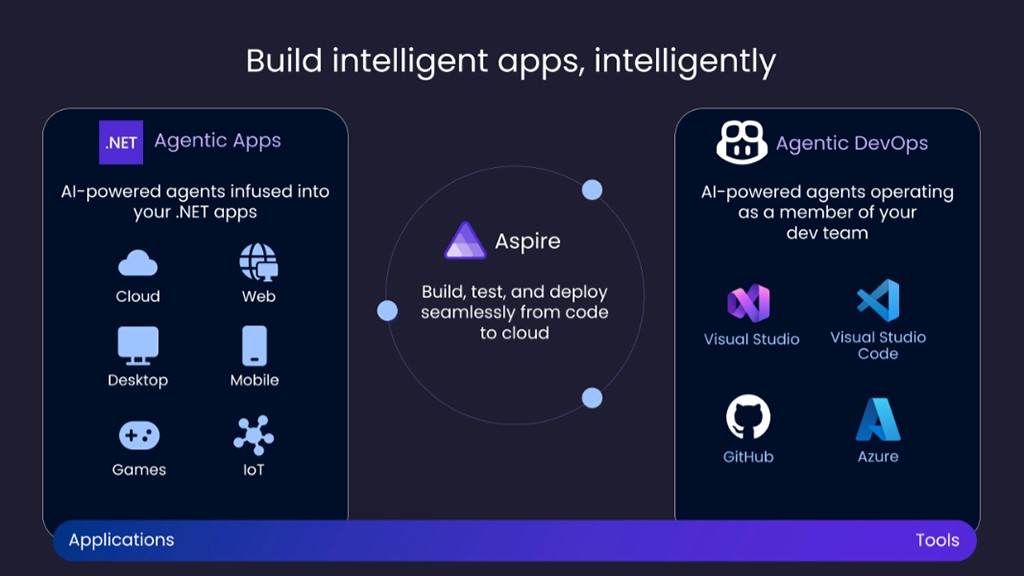
Microsoft has officially announced .NET 10 at the .NET Conf 2025 event, marking an important milestone in the evolution of the platform. As a Long-Term Support (LTS) release, .NET 10 will receive three years of security updates and official technical support, extending until November 10, 2028. Microsoft describes this release as the most efficient, modern, secure, intelligent, and high-performance .NET version to date.
NET 10 continues to uphold its core identity as a cross-platform, open-source, and completely free development platform, enabling developers to build a wide range of applications—from web, mobile, and desktop to games. Developed and maintained by Microsoft, the .NET ecosystem consists of a rich set of tools, libraries, and programming languages, with C# serving as its core language.
2. Microsoft SQL Server 2025
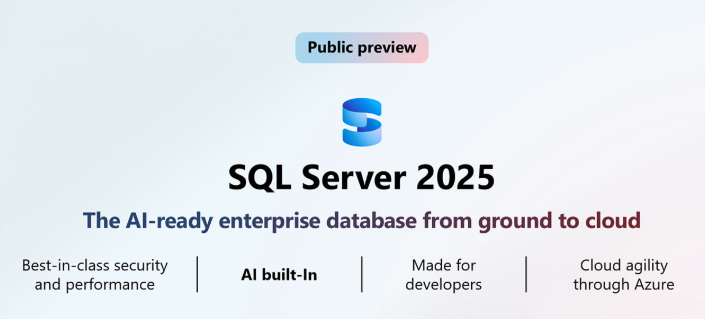
Recently, Microsoft officially released the preview version of SQL Server 2025, a release widely regarded as a breakthrough due to its deep integration of artificial intelligence (AI) into the enterprise database management platform. Could SQL Server 2025 truly be a game changer in data management and AI applications?
Deep AI integration: Combines vector search and keyword search within a single engine, enabling smarter and faster queries.
Support for modern application development: Native integration of JSON and REST APIs enables the development of cross-platform AI applications across cloud and on-premises environments.
Centralized data management with Azure Arc: Enables easier management, synchronization, and automation of data across multi-environment deployments.
Advanced security with Microsoft Entra: Strong identity authentication to help protect enterprise data.
Superior performance: Optimized data locking and accelerated query execution to handle high-volume workloads efficiently.
3. C# 14
- – Simplifying attributes using the keyword
- – Organizing data type extensions using extension blocks
- – Reducing code duplication by using partial methods and events
- – Improving readability through null-conditional assignments
- – Improve performance with user-defined compound assignment operators
- – Using parameter modifiers in lambda expressions without explicit type declarations
- – Optimizing Span usage with implicit conversions.
4. Green Software Development
Introduction to Green Software Development
Sustainable software development is an approach that integrates sustainability principles into every stage of the software life cycle, including design, development, deployment, and maintenance. The ultimate goal is to minimize the environmental impact of software products and systems.
Key elements of this approach include:
- – Energy-efficient programming practices
- – Product life cycle assessment
- – The use of green servers and data centers
Principles of Green Software Development:
- – Efficient resource management
- – Minimizing source code
- – Process optimization
Core benefits of adopting green practices:
- – Environmental benefits
- – Economic benefits
- – Social benefits
Six key strategies for green programming:
- – Algorithm optimization
- – Code refactoring
- – Efficient data management
- – Using resource-efficient programming languages
- – Using static code analysis tools
- – Dynamic resource allocation
Tools and technologies supporting sustainable development:
- – Energy consumption monitoring tools
- – Code analysis and optimization tools
- – Green frameworks and libraries
- – Cloud-based development environments
- – Sustainable deployment models
- – Automated testing and integration tools
The Future of Sustainable Software Engineering
As global attention to environmental sustainability continues to grow, software engineering is increasingly moving toward green practices.
Upcoming Innovations:
- – AI-driven optimization
- – Quantum computing
- – Product life cycle assessment tools
- -Service platforms
5. The Emergence of AI Agents in Visual Studio 2022 (v17.12+)
GitHub Copilot has evolved from a simple code suggestion tool into a powerful AI agent. In 2025, features such as Agent Mode in Visual Studio Code and Visual Studio enable AI to automatically perform complex tasks, including refactoring entire projects, generating unit tests for edge cases, and even identifying and fixing issues based on logs from Application Insights.
6. SQL Server Standard Edition: Hardware Limit Upgrades
Good news for DBAs in small and medium-sized enterprises (SMEs): Microsoft has increased the hardware resource limits for SQL Server 2025 Standard Edition.
- – RAM: Increased from 128 GB to 256 GB
- – CPU: Support for up to 32 cores. This enhancement alow on-premises systems to handle larger workloads without the need to upgrade to the more expensive Enterprise Edition.
7. End of Support for .NET 6 and .NET 7
The year 2025 marks the complete end of support for .NET 6 and .NET 7. Developers who continue to maintain projects running on these versions face significant security risks if they do not migrate to .NET 8 or directly to .NET 10.
8. Deep Integration of Microsoft Fabric and SQL Server
The concepts of OneLake and Mirroring have become increasingly popular. DBAs can now synchronize data from on-premises SQL Server to Microsoft Fabric in real time without the need to build complex ETL (Extract, Transform, Load) pipelines. As a result, data is immediately available for Data Science teams to analyze.
…
Contact us:
𝐇𝐢𝐤𝐚𝐫𝐢 𝐁𝐏𝐎 𝐒𝐨𝐥𝐮𝐭𝐢𝐨𝐧𝐬
𝐁𝐏𝐎 – 𝐑𝐏𝐀 – 𝐈𝐓𝐎
Address: 20 Nguyen Tri Phuong Street, Danang City, Vietnam.
𝐇𝐨𝐭𝐥𝐢𝐧𝐞: 0236 710 88 99
𝐄𝐦𝐚𝐢𝐥: info@hikaribpo.com.vn
𝐖𝐞𝐛𝐬𝐢𝐭𝐞: www.hikaribpo.com.vn
𝐅𝐚𝐧𝐩𝐚𝐠𝐞: Hikari Bpo Solutions Co., Ltd
𝐘𝐨𝐮𝐭𝐮𝐛𝐞: www.youtube.com/@hikaribposolutions